

The past few years I've written a post around this time outlining our curriculum plans for the upcoming year. ( Curriculum Choices (2013 - 2014) and Curriculum Choices (2014 - 2015) ) They were among my favorite posts!! They're all about books and supplies and planners and programs and systems and books, books, books, books!!
I was pretty bummed when I realized it would be repetitive and unnecessary to write a curriculum choices post this year; not much has changed. On the other hand, I'm super excited at the fact that this is the first year I'm not really trying out anything new!! For the past three or four years I've been researching programs, comparing methods, reading reviews from other moms, price shopping, and testing out new materials. And we finally don't need to do that again this year because I've found what works for us and we're sticking with that stuff! Yay!!
When September rolls around, the "start" of the school year will lack the thrill that nerds like me get when diving into a new program or curriculum. But in a way I'm looking forward to being back in the thick of it but feeling like it's "coming home" - being familiar and comfortable with all the methods and books and programs and not having to navigate anything new.
Here are some of the programs that I love and that work for us. So much so that we keep coming back to them year after year...
We've never used any other math program, so I can't compare Math U See to anything else. I just know that so far it's worked for us. It's a multi-sensory approach, so it can be a good fit for a family with children with different learning styles. Lessons are taught via DVD, there's practice and review in each chapter, concepts are taught using colored manipulatives, and you have the option of purchasing a CD of addition facts and skip counting songs. Something for everyone.
MUS's straight forward, systematic approach especially works for my oldest who doesn't need bells and whistles. He just wants to learn, practice, master the material, and move on. He's perfected skip counting by every number from listening to the CD, and that was enormously helpful in learning his multiplication facts. Math U See is a perfect fit for this kid.
For my second son, Math doesn't come quite as easily, but he benefits a lot from the "tricks" that are taught for adding and subtracting with different numbers. He also appreciates the application and enrichment activities included at the end of each chapter. He's often hesitant to use manipulatives because he feels it's an indication of his "weakness" in Math, but I usually just have to remind him that it's called Math U SEE and that the manipulatives are part of the see-ing, and he capitulates. Even though I think my second son would enjoy a math program that is in color and has more "fun" and engaging activities, Math U See seems to work well for him in that the straight-forward, no nonsense approach has nothing on the page to distract him.
Finally, Math U See hasn't only been good for my kids... Math was one of my weakest subjects all throughout school, and I've been SO enormously grateful for some of the tips and tricks that I've learned from Professor Demme's DVD lessons. Honestly, I've gotten much better at math by doing MUS with my kids! Yay!


I love Handwriting Without Tears. But not because there are actually no tears involved... I love it because it's so systematic and simple. I also love it because the workbooks are easy to use and once my "students" know the HWT method of forming each letter, I can let them practice independently. I check their pencil grip and that's about it until they're done and bring their work to me for review.
The first year I used HWT I bought the teacher guide (it was the Kindergarten level.) I'm glad I did, because by reading through it I learned the how's and why's of their approach. In my opinion, if you read one of their teacher guides, you don't need to purchase any for the other grades. Save your money and instead buy the HWT writing paper and notebooks/journals. Because HWT uses lined paper that is different from the "regular" 2 solid lines with the dashed line in the middle, it's worth having some of their "method" paper on hand for extra practice.
If you look into the HWT tears program, you will find that it can get a little gimick-y. It is designed for large classroom settings and so you can *maybe* see why a preschool or Kindergarten teacher might need "Mat Man" to teach kids about where parts of the body are or a bunny puppet to keep kids engaged....... However, as a homeschool mom, there are LOTS of things that HWT offers that I just don't need. If you are thinking about purchasing some of the "extras" for a Kindergartner or first grader, I would recommend (in addition to the workbooks, extra paper, and notebooks) the wood pieces for building letters (great for tactile learners) and the blue mat and capital letter cards that go with them. We've also had success using the slate chalkboard and the blackboard with double lines. I also have a set of their letter and number wall cards that I put in plastic sheet protectors and keep in a binder for my preschooler to trace with a dry erase marker. Obviously, all these things are extras, but I've appreciated having them for my younger kiddos.

Ugh. Are you sick of me talking about these? Sorry. I have to! Here's some of what I've already written...
In all fairness, I have to tell you that we've only used this program for one year, but I liked it enough that I bought the next level and we're using it again for this upcoming year. I had tried (and ditched) two different spelling programs before chatting with Erin enough to give AAS a go. After one year, I can easily see how this program builds solid spellers. It's in depth and thorough. It teaches spelling and phonics rules from the beginning and young kids are quickly spelling words beyond CVC words.
The teacher's guide is a must, but I was able to pick and choose which activities I used for each of the children in each lesson. (My younger son benefited from the letter tiles, while my older son found that activity to be tiresome.)
Note: we don't use All About Reading, but that hasn't hindered our progress through AAS.
 |
| (double digit multiplication in progress... the MUS way) |
We've never used any other math program, so I can't compare Math U See to anything else. I just know that so far it's worked for us. It's a multi-sensory approach, so it can be a good fit for a family with children with different learning styles. Lessons are taught via DVD, there's practice and review in each chapter, concepts are taught using colored manipulatives, and you have the option of purchasing a CD of addition facts and skip counting songs. Something for everyone.
MUS's straight forward, systematic approach especially works for my oldest who doesn't need bells and whistles. He just wants to learn, practice, master the material, and move on. He's perfected skip counting by every number from listening to the CD, and that was enormously helpful in learning his multiplication facts. Math U See is a perfect fit for this kid.
For my second son, Math doesn't come quite as easily, but he benefits a lot from the "tricks" that are taught for adding and subtracting with different numbers. He also appreciates the application and enrichment activities included at the end of each chapter. He's often hesitant to use manipulatives because he feels it's an indication of his "weakness" in Math, but I usually just have to remind him that it's called Math U SEE and that the manipulatives are part of the see-ing, and he capitulates. Even though I think my second son would enjoy a math program that is in color and has more "fun" and engaging activities, Math U See seems to work well for him in that the straight-forward, no nonsense approach has nothing on the page to distract him.
Finally, Math U See hasn't only been good for my kids... Math was one of my weakest subjects all throughout school, and I've been SO enormously grateful for some of the tips and tricks that I've learned from Professor Demme's DVD lessons. Honestly, I've gotten much better at math by doing MUS with my kids! Yay!


The first year I used HWT I bought the teacher guide (it was the Kindergarten level.) I'm glad I did, because by reading through it I learned the how's and why's of their approach. In my opinion, if you read one of their teacher guides, you don't need to purchase any for the other grades. Save your money and instead buy the HWT writing paper and notebooks/journals. Because HWT uses lined paper that is different from the "regular" 2 solid lines with the dashed line in the middle, it's worth having some of their "method" paper on hand for extra practice.
If you look into the HWT tears program, you will find that it can get a little gimick-y. It is designed for large classroom settings and so you can *maybe* see why a preschool or Kindergarten teacher might need "Mat Man" to teach kids about where parts of the body are or a bunny puppet to keep kids engaged....... However, as a homeschool mom, there are LOTS of things that HWT offers that I just don't need. If you are thinking about purchasing some of the "extras" for a Kindergartner or first grader, I would recommend (in addition to the workbooks, extra paper, and notebooks) the wood pieces for building letters (great for tactile learners) and the blue mat and capital letter cards that go with them. We've also had success using the slate chalkboard and the blackboard with double lines. I also have a set of their letter and number wall cards that I put in plastic sheet protectors and keep in a binder for my preschooler to trace with a dry erase marker. Obviously, all these things are extras, but I've appreciated having them for my younger kiddos.
(Emergent Reader Series and Decodable Literature Series.)

...the things that truly set this series apart from other reading programs are the engaging stories and delightful illustrations. There are no fat cats sitting on mats in this series, but there are cats who nap in camping equipment and a cat detective who investigates mysterious tacks and tan sacks. The stories are equally suited to boys and girls, they often convey wholesome childhood experiences (think running through a field to play fetch with your dog or going to the amusement park with the whole family). Several of the stories also feature (without fanfare or overtones of trying too hard to be "inclusive") children of different ethnic backgrounds and blended race families. (These are not themes of the stories, but are portrayed beautifully in the illustrations.) There are a handful of artists who provided the illustrations for the books, all of which are lovely. There are no stick figures or foolish cartoon characters here. The artwork is such that the child reading probably feels like he's reading a "real" picture book instead of a meticulously researched and planned out phonics-based reader.
They are the absolute opposite of typical make-mom-want-to-gnaw-her-arm-off readers. (Bob Books, I'm looking at you.).... The language and illustrations are truly enjoyable, even for adults; a mother won't feel compelled to bang her head against the wall as she sits by and listens.You can read my complete review of the Emergent Reader Series here. (This was one of the one-time expensive homeschool purchases that I'm soooo happy I did early on. The cost is justified by the fact that I anticipate using them with all my kids :) )
In all fairness, I have to tell you that we've only used this program for one year, but I liked it enough that I bought the next level and we're using it again for this upcoming year. I had tried (and ditched) two different spelling programs before chatting with Erin enough to give AAS a go. After one year, I can easily see how this program builds solid spellers. It's in depth and thorough. It teaches spelling and phonics rules from the beginning and young kids are quickly spelling words beyond CVC words.

The teacher's guide is a must, but I was able to pick and choose which activities I used for each of the children in each lesson. (My younger son benefited from the letter tiles, while my older son found that activity to be tiresome.)
Note: we don't use All About Reading, but that hasn't hindered our progress through AAS.
Story of the World (Audio Books)


Maps, Charts, and Graphs

I love this Geography series and so do my kids. They actually beg to do geography. When I say "it's time to do grammar," and my son gets super exited, I know that he misheard me and thinks I said "geography." (He hears what he wants to hear!) The lessons in these books are short, but complete, followed by questions to practice the new skill just introduced (understanding various kinds of maps, charts, and graphs... duh!) We've been using these workbooks for three (or maybe 4?) years and I've been so happy with them that I imagine that we'll keep using this series for as far and as in depth as it goes. I believe there are 8 levels (one per grade level from 1 - 8th grade)
Pretty sure these are nothing new for most homeschoolers out there. This will be our fourth year using STOW, but only our second year using the audio version of the books (read by another of our family favorites, Jim Weiss!) The audio books were a game-changer for us. They've made all the difference because we can listen to them in the car and so we're all getting a history lesson, instead of just the older kids. I can't recommend this series, especially the audio versions, enough!
Maps, Charts, and Graphs

Song School Latin

Teach Your Child to Read in 100 Easy Lessons

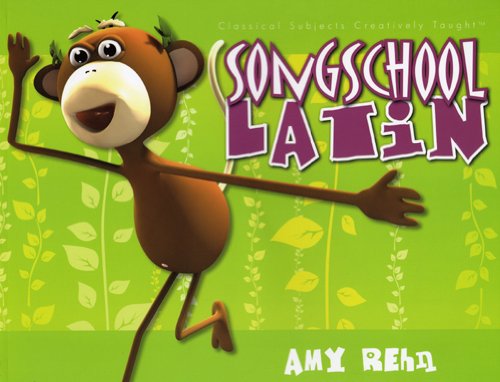
I just LOVE this gentle introduction to Latin for kiddos. The study center my kids attend use this program, but if we were ever to leave there, we'd still use it! The vocabulary songs are so fun, the workbook is easy to use. If you're considering starting Latin early, don't worry about starting with grammar and tricky stuff for your little ones. This is a fun for kids, manageable for mom, introduction to the language. After completing books 1 and 2 (my kids have done each book twice, actually) they'll be ready to start with Classical Academic Press' Latin for Children program with hundreds of vocabulary words and some basic grammar under their belts.

This definitely gets mixed reviews from moms, but if you're looking for no-nonsense, no frills, totally scripted reading lessons, this may be the program for you. Letter sounds are taught progressively, unlike some phonics reading programs that require your kiddos to know all the letter sounds before they can start reading anything. This program starts with simple sounds and simple words, then gradually adds in more sounds, including common blends and sight words. Kids are reading "stories" from the very beginning. I've successfully used this program while also using the Flyleaf Publishing books as supplements.


I have been so happy with this step by step learn to draw program. The books cover so many different topics that in the last few years, we've easily been able to choose drawing projects that coincide with specific things we're studying (animals and habitats, historical events, geography, etc...) Also included are paragraphs for copy work (only my older kids use these since, again, the triple lines can be confusing for young Handwriting Without Tears users.) I recommend these books for anyone interested in adding drawing to their weekly lessons. We've certainly used ours a lot!
Elemental Science (classical science program)
I'm tagging this on to the end here because even though we're not using it again this year, I really loved it :( If my boys weren't doing science at the study center, we would most definitely be doing Elemental Science again.
This past year we did Biology for the Grammar Stage. There is no text, but the parent guide provides the titles you need to complete the program. The boys loved the student workbook as well as the scientific experiments and demonstrations. I purchased the experiment kit, so we always had everything we needed and I wasn't left scrambling to try to find bizarro things around the house for experiments. One of the best features of Elemental Science is that they serve homeschoolers of different methods. You can choose their Classical approach (which we did, and can I mention again, we loved it?!), or their living books series for a more Charlotte Mason approach, or their lapbook-based program.
I often hear moms wondering what to do for science, if anything at all. For our first few years we just did a lot of nature study and interest-led reading (library book binges to the Nth degree...) but I decided last year we needed something a little more formal. I heartily recommend the Elemental Science program, especially if you're leaning more toward a classical approach to your homeschool. It's cyclical, as much of classical ed is, and if you stick with it, your students will cycle through biology, earth science and astronomy, chemistry, and physics approximately three times.
Do you have any favorite educational programs that you love and keep coming back to year after year? Or do you have any questions about mine? Ask away! I love chatting about this kind of stuff!!
Annnd... linking it up with Micaela at California to Korea. Head on over there to check out her vision and mission for the year, as well as the books and stuff they'll be using this year in their west coast homeschool!
You may also like...


