Showing posts with label diabetes memes. Show all posts

Tuesday, November 17, 2015

Guilt and Misunderstanding in the Juice Aisle (Diabetes Awareness Month, 2015)


When Aaron was diagnosed with diabetes over two years ago, I knew we'd have some new and unusual and scary issues to navigate.  But believe me, I never guessed how much drama there'd be over JUICE!!

We're not a juice family.  It's a health thing and it's a preference thing.  Juice is not the "health food" they market it as, and I just don't care for it that much (except for the occasional fresh squeezed orange juice that pancake houses serve in a shot glass for $4.99.  It's criminal... but oh, so delicious!) so I don't really serve it to my family.  

I think I can count on one hand the times our kids drink juice each year - they get orange juice at Easter brunch (cause the adults gets mimosas *glug, glug*!), apple cider at the Fall Soup Party and Thanksgiving, and maybe a sip or two on those Saturday mornings when my husband has one of his biannual I-must-have-juice-now!! episodes and runs out for a frozen orange juice concentrate leaving all the kids sitting at the breakfast table waiting like baby birds for him to come home with the delectable nectar.  

So, we don't really drink juice.   But we have a pantry stocked with juice.  And we never leave the house without juice.  And I have a bottle of juice in the glove compartment of both cars.  And the kids... all these kids I have... are frequently pestering me about can they drink the juice juice juice juice juice!?!

Aaron drinks juice.

And it is a constant source of conflict for me.

Because everyone knows that juice rots your teeth, and has little nutritional value compared to an actual piece of fruit, and juice spikes your blood sugar in a major way. 

Bingo.  Aaron drinks juice to spike his blood sugar in a major way.  

Since a diabetic's body does not naturally regulate blood sugar, if his glucose levels are  very low (hypoglycemia) they must be brought up immediately and artificially, to avoid severe complications such as comma, brain damage, and even death.  

Scary.  And that's why, despite all my instincts not to, I buy juice. 

For most diabetics the preferred methods of raising blood sugar quickly (because it must be done quickly) are juice, frosting, candy such as Skittles or Smarties, or glucose tablets.  It must be something with lots of sugar, little fat, and low to no nutritional value, because fat and nutritional goodness slow down the effectiveness of the sugar.  If a diabetic's blood sugar drops low enough that he is uncooperative, is too confused or incapacitated  to chew or swallow, or is unconscious, he will need an immediate emergency and life-saving injection of glucagon (a hormone that's kind of like the opposite of insulin.)  And believe me, ain't nobody want the glucagon...............


I mean, you might as well cue the Psycho music... right??  

So juice it is.  


And even though I know that juice is part of my son's life-saving first aid kit, I still feel guilty buying it.  


I hear little whispers  from the nutrition angel on my shoulder as I head for the juice aisle at the grocery store, "Juice is evil!!!  Don't purchase the evil!"  I hear the JAWS theme music play as I scan the shelves and reach for a six pack of apple juice.  I feel the piercing and disapproving stares of health-conscious shoppers as I put the juice in my cart and lower my eyes so that our gazes don't meet.  I act distracted and all "how'd that get there???" when I put the juice up on the checkout counter.


Ok, I know.  It's all in my head.  I mean, they don't really play the JAWS theme at the place where I shop.    


And I know I'm just imagining the piercing stares.  Seriously, no one else in the store cares what's in my cart.  No one is really judging me for buying juice.  

Except for the day that they did.

I was in the juice aisle, chatting to myself but making it appear less awkward by directing my mumbles in the general direction of the baby sitting in the shopping cart.  I crossed juice off my list and reached for a six pack.  

"Oh wait!  That's the low sugar kind," I said out loud to myself as I withdrew my hand, realizing my mistake.  


A nearby, well-meaning shopper overheard my private conversation with myself and said, "Oh sweetie, it tastes just as good as the other stuff and it's so much better for your kids." 

In retrospect, I should have been an on-the-spot type 1 diabetes educator, politely said, "Not for my child, it isn't," and given her my speech about the dangers of hypoglycemia and the life-saving properties of juice, frosting, and Skittles.  But I had that baby in the cart and four other kids in the grocery store kids play room, so I just laughed off her misunderstanding of the situation, found the juice I wanted (the kind with the extra double shot of sugary goodness), and bustled out of there. 

Cause the truth is, I sort of get it.  It goes against every fiber of my being to have juice in the cart, in the fridge, in the pantry, in the car, and in my purse.  But it's a diabetic's necessary accessory and in an emergency situation, that sugary, tooth-rotting, non-nutritive, sugar-spiking juice, could spike the sugar of the exact person that needs it to save his life.  


*   *   *   *   *   *

Know the signs of hypoglycemia:

shakiness
sweating, chills, clamminess
irritability, impatience
rapid heartbeat
lightheadedness, diziness
hunger, nausea
sleepiness
blurred vision
weakness, fatigue
lack of coordination
confusion
seizures
unconsciousness


*   *   *   *   *   *   *


*    *    *    *    *    *


I encourage you to read some of the other things I've written about 
diabetes and our family life.  And as always, please feel free to 
ask questions here!


What is Type 1 Diabetes? and Other Things You Can Learn From 

Highly Scientific Internet Memes


*   *   *   *   *   *

You may also like...


by Amanda Perales


Thursday, April 17, 2014

1 Year of Type 1 Diabetes :: Part 5 :: Day to Day

*Thank you for all the feedback for Aaron on his last video.  I was so happy to pass your kind comments on to him!*

*   *   *   *   *   *

Need to get caught up?  Read here:

*   *   *   *   *   *

Thanks so much for sticking with us through this mini series on Aaron's diagnosis of type 1 Diabetes.  We're wrapping things up with a look at what it's like having type 1 day to day - for a child and for his parents.  

When you leave the hospital with your newly-diagnosed-with-type 1 diabetes child your new task is to keep his blood glucose levels as even as possible.  This is the most insane and ridiculous and crazy task in the world.  A diabetic's levels will never actually be  "even" because there is no way for manufactured, injected insulin to work with the same delicate precision as a functioning pancreas and a body's natural insulin.  Maintaining decent levels can be stressful, frustrating, confusing, and overwhelming, especially in the beginning.   There's a steep learning curve that first year.  There are some major life adjustments that, once they become routine, don't seem so daunting.  But those first few months?  Daunting.  

Most of the "daily routine" of diabetes actually is routine now, both for Aaron and for Russ and I.  Aaron checks his blood glucose levels 4-6 times a day - before meals, before bed, before/during physical activity,  and if he's feeling "low." (Low blood sugar is dangerous in the short term - a diabetic can become unconscious and suffer brain damage in extreme cases.  Uncontrolled high blood sugars cause more problems in the long term.)  Some nights Russ or I (usually Russ, because he's awesome like that) check Aaron's blood 1-2 times (especially when we're testing out a new dose of Lantus insulin.)  Aaron receives an injection (more like an epi-pen than a huge syringe) of Humalog insulin during or after every meal (and some snacks) and one of Lantus at dinner.  Humalog is the insulin that covers the carbohydrates he consumes at meals and snacks, Lantus provides a slow-release/long lasting dose of insulin over a 24 hour period.   


When we leave the house, all the stuff comes with us.  So do glucose tabs, a juice box, and Smarties to treat lows.   And we always have our Calorie, Fat, and Carbohydrate Counter Book on hand.  

That's just the normal day-to-day stuff.  There's much more that goes into caring for Aaron.  "Special circumstances" that demand extra attention include physical activity,  illness, dental work (happening this weekend...), stressful situations (like test-taking),  cuts and infections, dry skin, and so on...

A year later... it's mostly routine.  But that doesn't mean it's easy.  

Even now,  Aaron still gets blood glucose readings that completely baffle us.  What???  We TOTALLY counted that bowl of oatmeal and fruit right!!!  What do you mean he's at 387 before lunch???  (Optimal blood glucose levels are around 100.)  


There are days we completely forget all about diabetes and we plan a super fun outing and we leave for the day without a stitch of testing equipment or a drop of insulin.  Wake up, people!  It's been a year!  It's a situation that makes for a lot of parental guilt, stress, and ridiculous numbers later in the day...


hehe... remember this guy!!
Aaron visits a pediatric diabetes clinic every three months to meet with his endocrinologist, a fellow or a resident, a certified diabetes educator, and a nutritionist.  And even though we've been trying really hard to get carb counting right and insulin dosing accurate, he still gets high results on his A1C readings.   Ahhhhh!!  We're really trying hard, I swear!  (The A1C test gives a broader picture/average of what blood glucose levels have been like over the past 2-3 months.)   I just try to be prepared for the fact that the endo will probably never use the adjective "level" to describe his actual "levels."  


It really can be crazy trying to juggle it all - at home, on the road, with other kids under foot, and on top of all the regular old craziness of everyday life.  But the feelings of stress, anxiety, and frustration of which I speak are mostly just in reference to myself and Russ.  Aaron has been the least phased of all by all his diagnosis and treatment.  What a blessing to have a child that isn't resistant to all that goes into caring for him.  I can't imagine the additional difficulties faced by a family in which the newly diagnosed child is resistant to the needles and the extra time and "stuff" that surround meal times.  They have my prayers and sympathy.  Aaron occasionally has a mini-complaint about caring for his illness, but for the most part, he's fabulous.  Here he is to conclude this mini series.  He will show you what it's like to check his blood and receive insulin at snack time.  It's real life - totally unedited, including the part where he wipes his bloody finger on his shirt.  (I'm so embarrassed!)  


Monday, April 14, 2014

1 Year of Type 1 Diabetes :: Part 4 :: What is Type 1 Diabetes? and Other Things You Can Learn From Highly Scientific Internet Memes

Our son, Aaron, was diagnosed with Type 1 Diabetes a year ago.   He and I have been working together on a few posts to share his story with you.  


*   *   *   *   *   *

(Read Part 1Part 2, and Part 3 here)

*   *   *   *   *   *

Part 4
What is Type 1 Diabetes?  And Other Things You Can Learn From Highly Scientific Internet Memes


What is type 1 diabetes?  I didn't know before Aaron was diagnosed.  If anything, I shared the most widely-held misconception that diabetes was something that was obviously caused by poor diet and lack of exercise and was controlled by healthy diet and increased activity.   Even though that's what I thought, it didn't entirely make sense since I knew that Aaron was active and that he had a balanced diet - mostly healthy food with occasional, portion-controlled treats and desserts.  When our pediatrician first indicated that Aaron's symptoms were pointing toward diabetes, I thought our son would never have another cupcake again and that our whole family would be starting up a new nutrition and exercise plan.  Wrong-o.  We quickly learned what it isn't and all that we would have to do to treat what it is.  

You can enter "what is type 1 diabetes" into any internet search engine and get all the information you're looking for.   But I'm going to give it to you in my own words based on our experience and information from the book The Everything Parent's Guide to Children With Juvenile Diabetes** (M. McCarthy) and it will obviously highlight the things that stand out to me, a parent caring for a young diabetic.  And maybe we can have a laugh along the way! 

**This is great resource book, but I've never understood why they reference "Juvenile" diabetes in the title, since that misnomer has been replaced with "Type 1" and they say as much in the book.  So????


hint: if it's lifelong and you won't grow out of it...
What is type 1 diabetes?
Type 1 diabetes is an autoimmune disease in which the body's immune system mistakenly attacks a healthy pancreas and destroys the beta cells which produce insulin.  


Our bodies break down the food we eat into its various components, one of which is carbohydrates.  The carbohydrates we eat are converted into glucose, a form of sugar that is consumed by our cells for energy.  Glucose, delivered by the blood stream,  is food for our cells.  Insulin is the "link" that facilitates the absorption of glucose into the cells.  Without insulin, glucose is not able to enter the cells and instead remains in the blood stream, causing high blood glucose levels, or hyperglycemia.  The cells will not be "fed" and the body goes into "starvation mode."  

***  yay!  we made a movie ***
"What Is Type 1 Diabetes"
by Aaron

                   
(Aaron is so serious in the movie!  I kept encouraging him to smile and act friendly, but he kept telling me that he wanted everyone to understand how serious this is...  We're going to work on his presentation skills!  At least he didn't repeatedly yawn in this one like in an earlier one we tried!)

Type 1 and Type 2 Diabetes are different illnesses.
Only about 5 percent of Americans with diabetes have type 1.   It  stands to reason that type 2 is more widely understood, and this can cause confusion and misunderstanding since the two types have some significant differences. 

A person with type 1 has an autoimmune disease and his body will never produce insulin again.  


this message brought to you by your formerly functioning pancreas
Type 2 diabetes is a metabolic disease in which a person's body still produces insulin but has a difficult time using it properly, or it doesn't produce enough insulin.  A person with type 2 can potentially improve their health and/or blood glucose levels with diet and exercise.  A person with type 1 should obviously eat properly and exercise, but these will not change the "status" of his diabetes.

What causes type 1 diabetes?
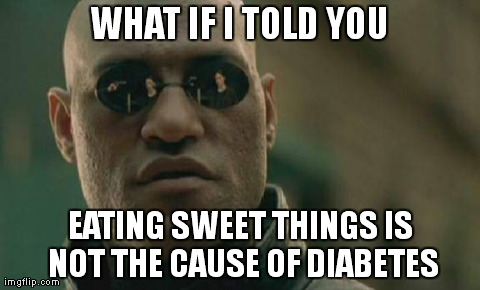
Scientists (how's that for generic) believe that it is a combination of a genetic predisposition and an environmental trigger (often a virus) that "sets off" the autoimmune response.  Type 1 diabetes is not caused by what a person eats or doesn't eat (sugar or anything else)  or by exercise levels.   It is not caused by drinking full-sugar pop (some of you may call it soda), and it is not a result of being born via c-section or not having been breastfed as an infant, or any other of the wacky things you may hear.  There is nothing a diabetic (or his parents) could have done differently to avoid the onset of type 1 diabetes.  


Is there a cure for type 1 diabetes?
Unequivocally, no.  There may be in the future, but now - no.  


The insulin-producing cells in the pancreas of a person with type 1 diabetes have been attacked and damaged beyond repair.  They will not "heal" or "regenerate" or "recover"  or mysteriously start producing insulin again.  (Except in the case of a miracle!!)  

Type 1  cannot be cured with an extreme diet - including whole foods, vegan foods, or carbohydrate free foods.  It cannot be cured with cinnamon.  


Those generic scientists I mentioned earlier... they are working on the development of an artificial pancreas which may some day make the lives of type 1 diabetics easier.  But there will be no cure until there is a way to induce the body to make its own insulin again.

But doesn't insulin cure the diabetes?
Insulin is not a cure.  It is a treatment.  However, it is not a medication.  In fact, it is a hormone that everyone needs for their body to function properly; people with type 1 get it by injection.  


Can a person with type 1 diabetes eat whatever they want?
No.


And yes.


So, no, they can't eat whatever they want and expect to stay healthy any more than you or I.  Just as I can't eat anything I like whenever I want and hope to stay healthy, neither can a diabetic.

But also, yes.  They can eat whatever they want.  Unless there are other dietary factors in play, (for instance, some diabetics also develop celiac disease, another autoimmune disorder) a person with type 1 diabetes will generally not have any food restrictions.  


This is perhaps the most difficult concept to come to terms with or to convey to others.  It is not wrong or bad for my son, Aaron, to have a cupcake.  He may have a cupcake at a party without "breaking the rules" and without guilt just as I may have a cupcake at a party without worry or guilt.   His diabetes will not be better or worse for the cupcake.  After we both eat our cupcakes, I  won't even be thinking about the insulin my body is pumping out to usher glucose into my cells.  What I will be thinking about is how much insulin Aaron will need by injection to "cover" the tasty (guilt-free) cupcake he just ate.  

So do people with diabetes really use needles all day long?
Yes.  More on that next time!  


*  *  *  *  *  *

Check back later this week for Part 5!

*  *  *  *  *  *

St. Josemaria Escriva, pray for us!
Related Posts Plugin for WordPress, Blogger...